Hey There, Let's Chat About This Journey
Right now, I'm diving headfirst into the world of system design, and I figured the best way to really grasp it is by sharing my progress openly with everyone.
This piece fits into my ongoing exploration series called "System Design Essentials," where I'm breaking things down from the ground up as a total newbie.
Keep in mind, I'm no pro here—this is just me figuring things out in real time, talking about:
- the bits that click for me,
- the parts that still puzzle me,
- and the fresh insights I pick up as I go.
Ultimately, it's all about creating a steady habit, gaining sharper understanding, and sparking some great conversations.
What We're Digging Into Today
In this discussion, I'll walk you through:
- the essence of the client-server setup,
- figuring out roles for clients and servers,
- how the back-and-forth of requests and replies happens,
- breaking down what's packed into an HTTP request and its reply,
- comparing servers that forget versus those that remember (with some easy analogies),
- and scaling from one server to a whole team of them.
Check Out My Code Collection
I've got all my scribbles, sample snippets, and hands-on experiments stored in one spot:
👉 GitHub Spot: https://github.com/dmz-v-x/system-design-101
I keep adding to this as my learning adventure rolls on.
My Takeaways from Studying This
First Off: Unpacking the Client-Server Setup
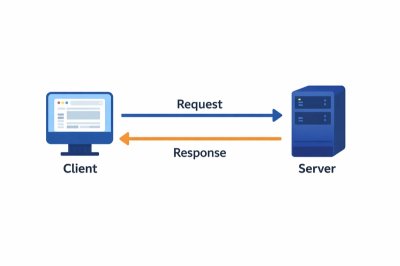
At its heart, this whole thing boils down to a pair of devices: one playing the role of the asker, and the other stepping up as the provider.
The asker side reaches out for info or action, while the provider side delivers what's needed.
That's the straightforward backbone of how client-server interactions work.
A Deeper Look to Make It Click
Think of the client-server approach as a blueprint for building systems where:
- the starting point is a request from one end,
- the other end handles the ask and fires back an answer,
- and all this chatting happens across some kind of connection link.
Now, let's zoom in on what each piece really does.
Spotting the Client in Action
Essentially, the client is the one kicking things off by sending out a query.
Some everyday examples include:
- web explorers like Safari or Edge,
- apps on your phone, whether for Android or Apple devices,
- command-line helpers such as Postman or fetch,
- even one service in the background calling on another (think interconnected apps).
🚨 Quick heads-up on a common mix-up:
- It's not just limited to web browsers,
- sometimes a behind-the-scenes system acts as the client to yet another system.
Defining the Server's Job
The server hangs out, ready and waiting for incoming asks from clients, then crunches the details and shoots back a fitting reply.
A few types you might run into:
- servers handling web pages,
- databases that store and retrieve info,
- file storage systems,
- or even email handlers.
How Requests and Responses Flow
Imagine you're ordering takeout: you (the client) call the restaurant (the server) with your order details. They prepare it and send it your way. In tech terms, the client crafts a message with specifics like what it wants, and the server processes that, then returns results or confirmation.
This exchange typically rides on protocols like HTTP, ensuring smooth, reliable back-and-forth over networks.
Peeking Inside an HTTP Request and Response
Let's get hands-on with HTTP, a common protocol. An HTTP request usually packs:
- a method (like GET for fetching or POST for sending data),
- the target address (URL),
- headers with extra info (e.g., content type or authorization),
- and sometimes a body with more details.
On the flip side, the response includes:
- a status code (200 for success, 404 for not found),
- headers,
- and a body with the actual content or error message.
It's like a structured conversation with clear labels.
Stateless Servers vs. Those That Remember
Picture a stateless server as a forgetful barista who treats every coffee order like it's from a stranger—no recall of your usual. Each request stands alone, making things simple and scalable, like standard HTTP.
Stateful ones, though, are like your regular spot where they know your preferences. They hold onto info between interactions, which is handy for sessions but can complicate scaling.
From Solo Server to a Full Squad
Starting small, a single server manages everything—easy to set up but a bottleneck under heavy load.
Switch to multi-server setups, and you distribute tasks across several machines, boosting speed and reliability. Think load balancers directing traffic to keep things humming.